

Your associate pastor opens their calendar Monday morning and notices something new.
🎧 Listen to this episode:
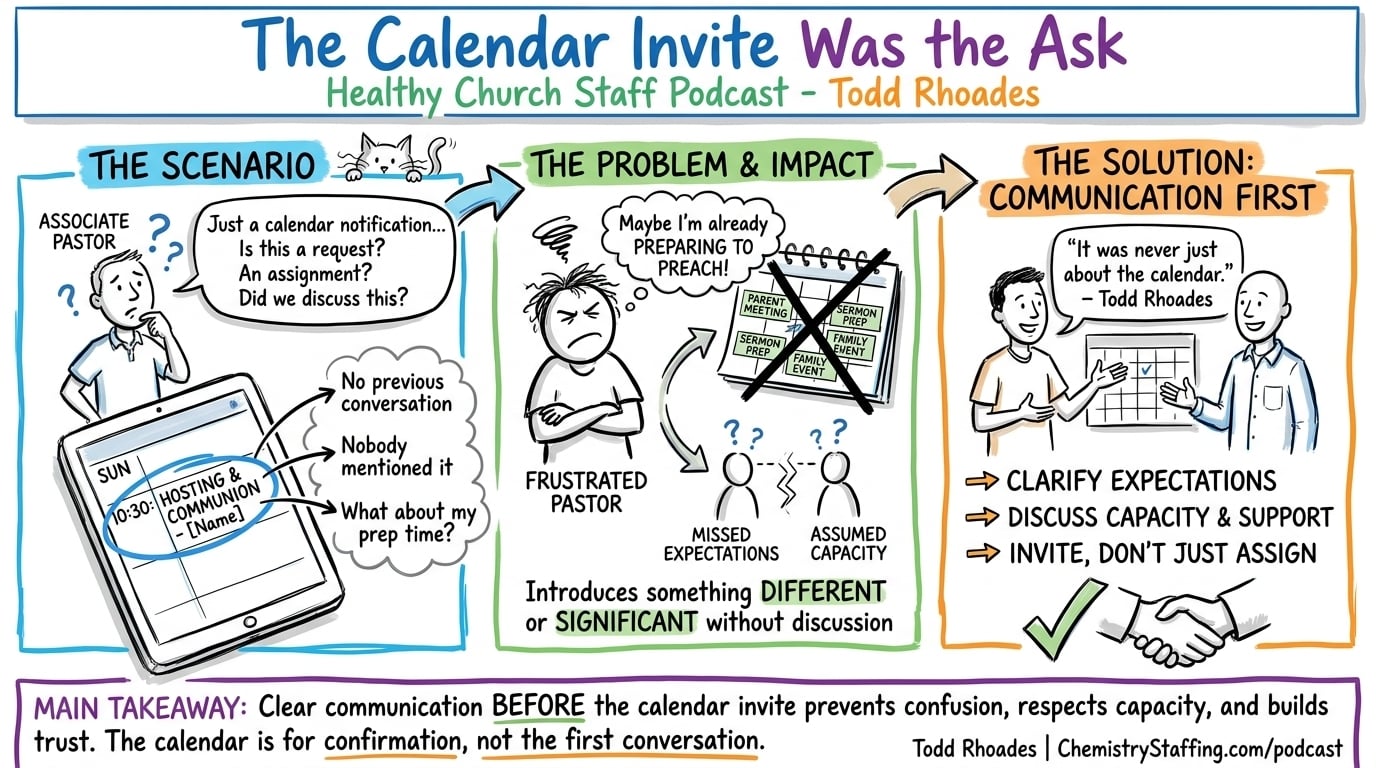
Sunday. Ten-thirty. Hosting and communion. Their name is on it.
Nobody mentioned it last week. There wasn't a conversation about preparation or what else they're carrying this Sunday. Just a calendar notification and an Accept button.
Now they're wondering: Is this a request? An assignment? Or something someone thinks we already discussed?
If this scenario sounds familiar, you're not alone. Scheduling tools have revolutionized church administration, helping us coordinate people, confirm details, and keep Sunday from becoming complete chaos. But they work best when people understand the expectations behind what appears on their screen.
Today, let's talk about how we assign work—especially when a calendar invitation becomes the first conversation.
The Calendar Can Only Tell Part of the Story
Here's an important distinction to start with: some scheduling is simply part of an established role.
If your associate pastor regularly hosts services and everyone understands how that rotation works, putting the next date on the calendar is perfectly reasonable. You don't need a separate negotiation for every ordinary responsibility. Leaders need to assign work, and teams need reliable ways to receive those assignments. No problem there.
The problem comes when the calendar introduces something different—a significant responsibility you haven't discussed, or assumes capacity you haven't checked.
Maybe hosting is familiar, but this week they're already preparing to preach. Maybe leading a parent meeting is new, and they need information before they can do it well. Or maybe the event falls outside their normal schedule and affects personal plans you know nothing about.
The calendar can show you an open hour. It won't necessarily show you the work surrounding that hour.
Three Principles for Clearer Communication
1. Remember That Scheduled Time and Preparation Time Are Different
This is the first thing every church leader needs to internalize: what appears on the calendar is rarely the full picture of what you're actually asking.
A twenty-minute presentation might require several hours of preparation. Hosting a service might include reviewing announcements, coordinating transitions, checking in with multiple people, and understanding a sensitive moment you personally want handled carefully.
When you assign the visible part, make sure you're accounting for the work that makes that visible part possible. Otherwise, you may think you've added fifteen minutes to someone's week while your staff member is trying to figure out where they'll find half a day to prepare well.
Proverbs 27:23 - "Be sure you know the condition of your flocks, give careful attention to your herds."
Good shepherding (leadership) requires knowing our people deeply, not just managing their calendars.
2. Make the Nature of the Request Crystal Clear
Are you asking whether they're available? Assigning a responsibility within their role? Checking whether they'd like an opportunity to develop a new skill?
These are fundamentally different conversations, and they require different approaches.
If it's an assignment, communicate it honestly and give them a way to raise conflicts: "I need you to lead Sunday's welcome. Before we finalize it, let's look at what you're already carrying and what preparation you'll need."
If it's optional, make that clear too: "Would you be interested in leading this? It's fine if the timing doesn't work."
Calling something an "invitation" while treating a decline as an attitude problem creates the kind of confusion you can easily avoid. Your staff needs to know what you're asking and what room they have to respond.
Discussion Question
Think about your recent calendar invites to others. If someone reviewed just your meeting requests from the past month, what would they conclude about your relationship with them? Would they feel valued or utilized?
3. Give Them Enough Information to Succeed
What exactly are they responsible for? What outcome are you looking for? Who else is involved? When do they need to be ready?
You may have already pictured the whole event in your head. They may have six words in a calendar description to work with.
A short conversation can close that gap.
For a familiar responsibility, a clear message may be enough. But for something substantial, unfamiliar, or sensitive, take the time to talk face-to-face. Then use the calendar to capture the details so everyone can find them later.
One of the biggest enemies of communication in church staff culture is the false efficiency of digital communication. I've been in church offices where every door is closed, everyone's on their computer, and they're emailing someone in the next room.
Don't let convenience replace connection.
Make Room for Honest Capacity Conversations
Here's what healthy teams do differently: they make it safe for staff to tell you when assignments collide.
Someone on your team should be able to say, "I can lead that meeting, but I'm also finishing the volunteer training you asked for. Which should take priority?"
That's not pushback—that's useful information.
Responding well helps you make a better decision. It also teaches your team that raising a capacity concern is part of responsible work, not a character flaw. You don't want people quietly accepting everything and hoping they can somehow finish it all.
Philippians 2:3-4 - "Do nothing out of selfish ambition or vain conceit. Rather, in humility value others above yourselves, not looking to your own interests but each of you to the interests of the others."
One Thing You Can Do This Week
If this has been an issue on your team, here's a simple place to start:
Review the next responsibilities you're about to schedule. Look at those calendar invites you're ready to send. Ask yourself whether they're part of an understood routine or whether they introduce something new into that person's workflow.
For new or significant work, make contact before finalizing the assignment. Explain what's needed, check their existing workflow, clarify the priorities.
And if you've already sent an unclear invitation? You can fix that with a simple message: "Hey, I put that on your calendar before giving you the context. Let's talk through what I'm asking and see how that fits with your week."
Action Items for Your Team
- Conduct a calendar audit: Each staff member reviews their meeting requests from the past month and identifies how many included adequate context and preparation time.
- Create a team agreement: Establish which responsibilities are routine (can be calendared directly) and which require conversation first.
- Implement a "context check": Before sending any calendar invite for a new or significant responsibility, ask yourself: "Does this person have everything they need to succeed?"
- Schedule brief check-ins: For team members carrying multiple projects, establish a weekly five-minute capacity conversation to prevent calendar pile-up.
You Don't Need a Complicated Process
Please don't hear this and create another multi-step approval process. You don't need a complicated system.
But you do need clear expectations, reasonable notice, and a conversation when the work calls for one.
The next time you're about to add someone's name to a calendar event, pause for just a moment. Make sure they understand not just the time commitment, but the responsibility that comes with it. Make sure they have what they need to succeed. And make sure they know they can tell you when their plate is already full.
That's not just better management—it's better discipleship.
What's your biggest challenge with team communication and calendar management? I'd love to hear your story. Send me your thoughts at podcast@chemistrystaffing.com.
And if your church is navigating staffing challenges—whether that's hiring, compensation, succession planning, or building a healthier team culture—that's exactly what we do at Chemistry Staffing. Reach out, and let's talk about how we can help.