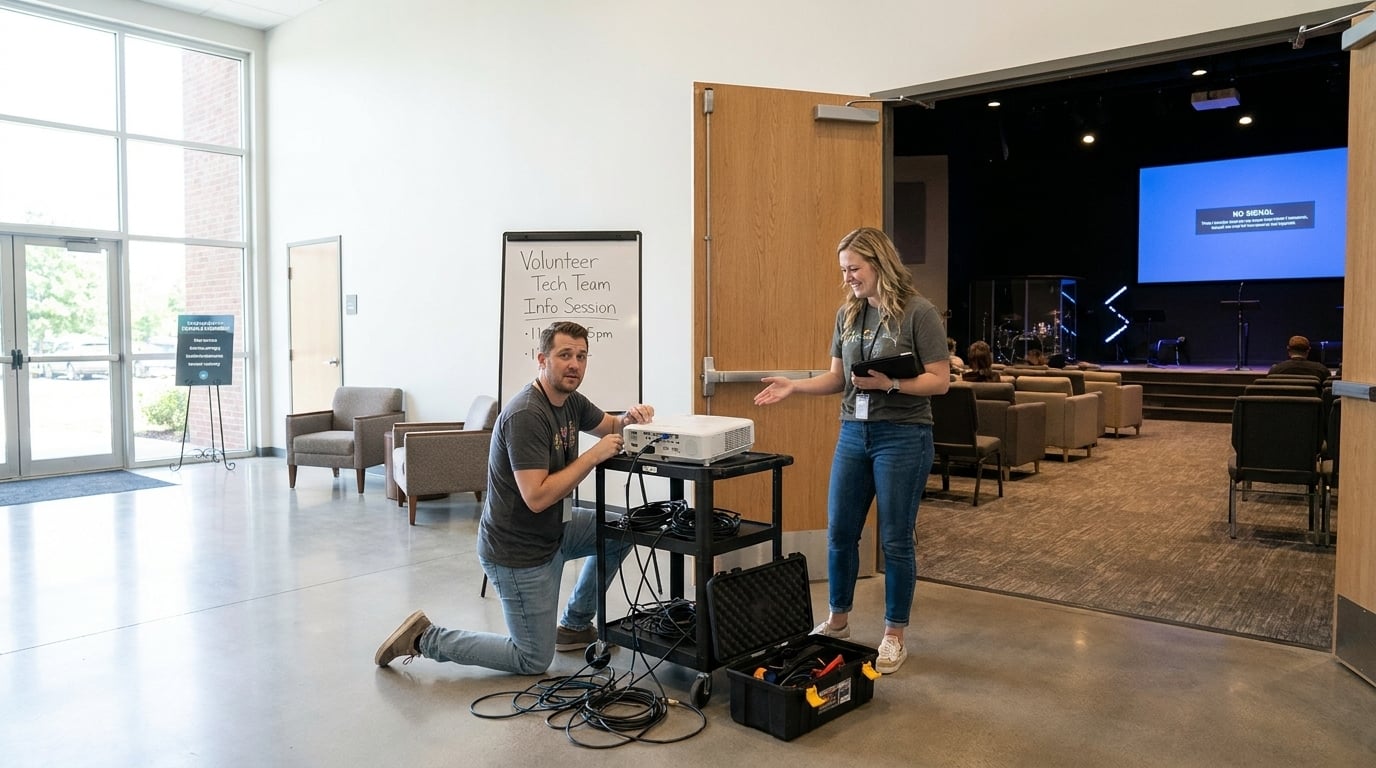
Your associate pastor fixed the projector five minutes before the service started.
🎧 Listen to this episode:
Everyone breathed a sigh of relief. You thanked them profusely. The slides appeared right on cue, and Sunday moved forward without a hitch.
The following week, someone asked them to look at a problematic microphone. Then the livestream had an issue. The children's check-in system froze. Someone couldn't connect to the office printer.
Before long, every technical problem in your building came with the same instruction: "Ask Chris. Chris knows how to fix that stuff."
There's just one problem: You hired Chris to lead discipleship.
If this scenario sounds familiar, you're not alone. Churches everywhere are wrestling with what I call "accidental ownership"—when a staff member becomes the go-to person for responsibilities they never agreed to take on, simply because they helped out once or twice.
How Innocent Helpfulness Becomes Permanent Ownership
Let's be clear: this usually starts with the best of intentions. Something breaks, someone steps up to help, and you discover a skill you didn't know they had. That's genuinely a good thing. Churches thrive when people share their abilities and collaborate beyond their formal job descriptions.
But there's a critical point where occasional help crosses over into ongoing ownership—and that transition happens without anyone really noticing or discussing it.
Chris stops being someone who can help with a technical problem. He becomes the person everyone expects to solve it. And that change absolutely deserves a conversation, because the work has to fit somewhere.
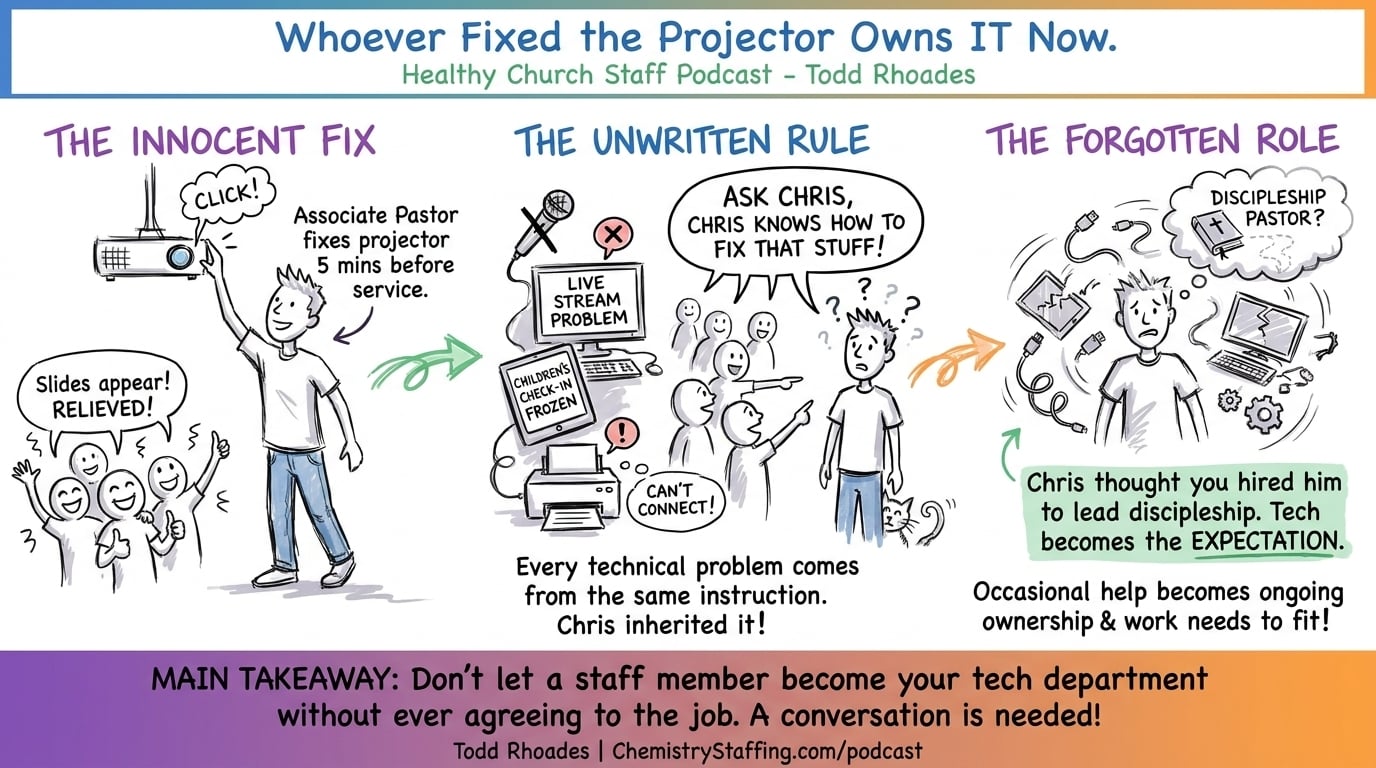
Think about it: If Chris spends Sunday morning troubleshooting the livestream, he misses the volunteer meeting he was supposed to lead. If Monday afternoon disappears into resolving a network issue, his preparation for small-group training gets pushed to Monday night—cutting into time with his family.
You might see a dependable staff member keeping things running smoothly. But he may be looking at a calendar where his actual job keeps getting squeezed into the margins because he's the only one who knows how to fix "all those tech things."
Exodus 18:17-18 - "Moses' father-in-law replied, 'What you are doing is not good. You and these people who come to you will only wear yourselves out. The work is too heavy for you; you cannot handle it alone.'"
Step 1: Discover What They're Actually Carrying
If you suspect this might be happening on your staff, the first step is simple but essential: sit down and find out what they're actually carrying.
Ask directly: "What technical responsibilities have become yours that we've never really discussed?"
Then let them walk you through a normal week—including the preparation time, the interruptions, and the follow-up work. You might discover that a "five-minute fix" actually required an hour of troubleshooting that happened completely behind the scenes.
Also ask what they feel responsible for simply because nobody else knows what to do. That answer may reveal a much broader scope of work than you ever intended to assign.
Step 2: Decide Who Should Actually Own Each Responsibility
Once you understand what's really happening, it's time to make some intentional decisions about ownership. But here's a critical mistake to avoid: treating every technical skill as interchangeable.
Running a sound console, managing an office network, and supporting a children's check-in system are genuinely different kinds of work. Someone who knows how to make a slide appear may have zero expertise in network security or equipment repair.
You need a realistic understanding of what your staff and volunteers can actually support—and where outside help makes more sense.
Now, I'm not suggesting every small church needs a full-time technology director. That's not realistic or necessary for most congregations. But it might mean:
- A trained volunteer handles service production
- An outside provider supports your office network
- A staff member coordinates those relationships rather than doing all the hands-on work
Or—and this is perfectly fine too—it might mean that technology does become an intentional part of Chris's role.
Step 3: If Tech IS Part of Their Role, Make It Official
If you decide that Chris should own certain technical responsibilities, that decision needs to be formalized. Here's what that conversation should include:
Does he actually want this responsibility? Don't assume. Ask.
What training does he need? If you're going to give him this responsibility, equip him to do it well.
What else changes on his plate? You can't just add significant responsibilities without removing something else.
Does compensation need to be reviewed? When the scope of someone's job expands significantly, compensation should be part of the discussion.
What are his priorities? This is critical. If Chris is leading a discipleship event and the office printer stops working, which responsibility comes first? He shouldn't have to negotiate that question every time someone appears in his doorway with an urgent problem.
Questions for Your Next Staff Meeting
- What tasks are team members currently doing that aren't really their job—they just picked them up at some point and never put them down?
- Why do we struggle to transition temporary fixes into proper long-term solutions? Is it a resource issue, a systems issue, or a culture issue?
- What would need to change about how we operate to create safety for people to help solve problems WITHOUT being afraid they'll own it forever?
Step 4: Build Support Systems Around the Work
Whether tech responsibilities stay with Chris or move to someone else, you need backup systems in place. Start with the functions that matter most on Sunday mornings.
For each critical function, identify:
- Who normally handles it
- Who can provide backup support
- What to do when the usual fix doesn't work
Write short checklists. Let the backup person practice while the experienced person watches. Reading instructions is helpful, but actually starting the stream or setting up check-in reveals what the instructions missed.
And here's something most churches never do: Agree in advance on what happens if something can't be fixed immediately. Can the service continue without the screen? Is there an established alternative when check-in is unavailable? Who decides when to stop troubleshooting and implement Plan B?
These decisions are much easier to make calmly on a Thursday afternoon than with a roomful of people waiting on Sunday morning.
Galatians 6:2, 5 - "Carry each other's burdens, and in this way you will fulfill the law of Christ... for each one should carry their own load."
There's a difference between helping temporarily (burdens) and enabling unhealthy permanent dependencies (loads).
Your Next Step: The Three-Responsibility Audit
Here's something practical you can do this week: Meet with your "accidental tech person" (or whoever has quietly accumulated responsibilities beyond their job description).
Together, identify the three responsibilities creating the most disruption to their primary role. For each one, agree on:
- Who will own it going forward
- What support they need to make the transition
- A specific date for making the change
Then—and this is essential—actually follow through.
Keep appreciating the person who steps in during a crisis. But also give them a clear answer about what happens after the crisis ends.
Helping once should open a conversation about their skills and how to best use them. It shouldn't quietly rewrite their entire job description.
Action Items to Implement This Week
- Conduct a Role Audit: Have each staff member write down their actual daily/weekly tasks for two weeks, then highlight what's in their job description vs. what they've accumulated.
- Identify Your Top 3 "Orphan Tasks": Name the three most important responsibilities currently being done by whoever-last-touched-it. Assign a clear owner to each.
- Create Permission Statements: Draft phrases your team can use without guilt, like "I can help you find the solution, but I can't own this long-term."
The Bottom Line
Your church benefits when people share their gifts and help each other. But there's a difference between being a team player and being quietly overwhelmed by responsibilities you never signed up for.
If you've got a Chris on your staff—someone carrying responsibilities that have simply accumulated over time—you owe them a conversation. Not someday. Soon.
Because the most valuable thing you can give a capable staff member isn't more appreciation for doing everything. It's clarity about what they're actually responsible for and permission to focus on the work you actually hired them to do.
What responsibilities have "accidentally" landed on your plate or your team members' plates? I'd love to hear your story. Email me at podcast@chemistrystaffing.com.
And if your church is wrestling with role clarity, compensation questions, or hiring decisions, that's exactly what we help churches navigate at Chemistry Staffing. Reach out—I'd love to start a conversation about how we can help.
This post is based on episode 733 of the Healthy Church Staff Podcast. Listen to the full episode here.