

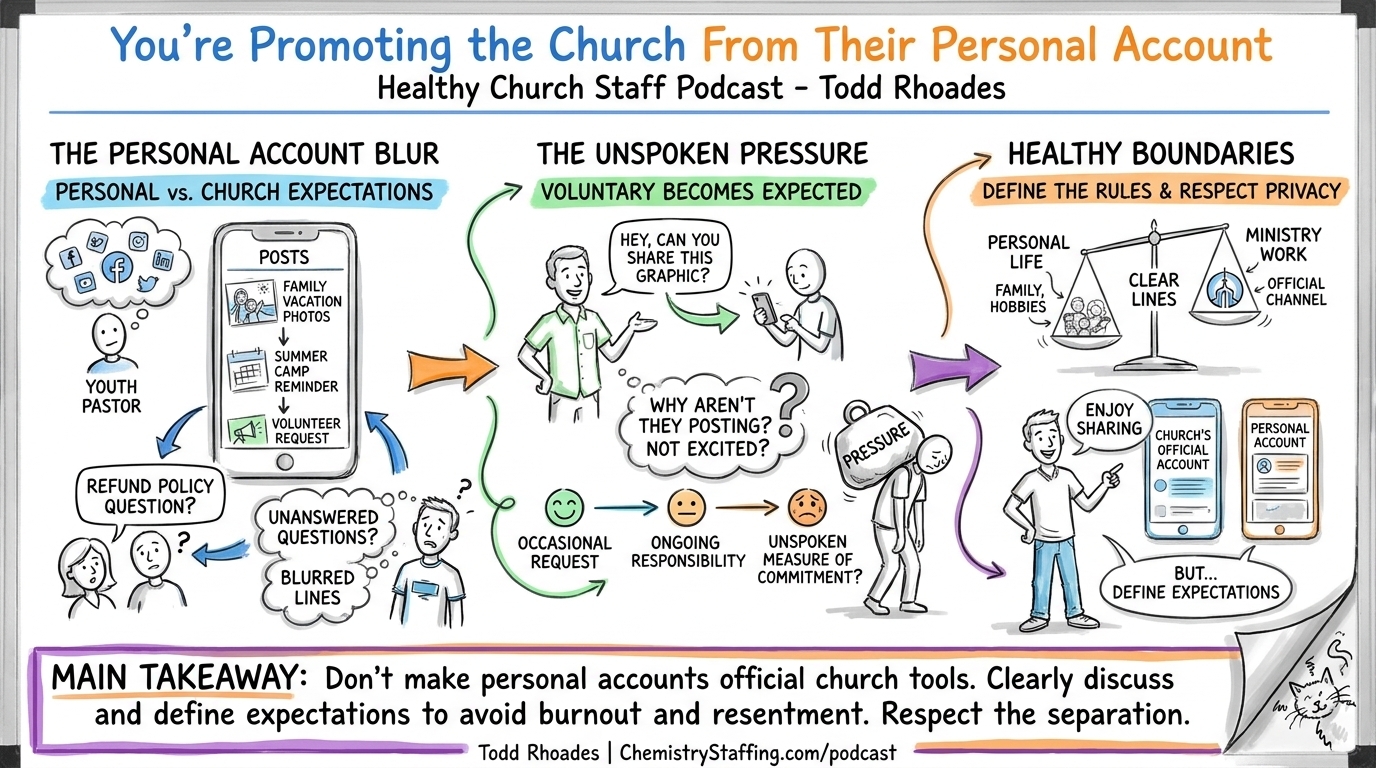
Picture this: Your youth pastor posts vacation photos on Instagram. Sandwiched between family snapshots is a reminder about summer camp registration. Above that, a volunteer request. In the comments, a parent is asking about the church's refund policy.
🎧 Listen to this episode:
Sound familiar?
At some point—probably without anyone noticing—their personal account became another customer service channel for the church. Maybe they're comfortable with that. Maybe they genuinely enjoy sharing what's happening in ministry.
But here's the real question: Has anyone actually asked if this is okay?
I'm Todd Rhoades, co-founder of Chemistry Staffing, and today I want to talk about something that's becoming increasingly common—and increasingly problematic—in church leadership: the unspoken expectation that church staff will use their personal social media accounts to promote the church.
How an Invitation Becomes an Obligation
It usually starts innocently enough. You create a great graphic for Easter services and send it to your worship pastor: "Hey, would you mind sharing this?"
They do. People respond. It works.
So next week, you send another request. And another. Eventually, sharing church content becomes something you count on—something you expect. And when they don't post, you start to wonder if they're even excited about what the church is doing anymore.
That's a significant change. What started as an invitation to share has quietly become an unspoken measure of commitment.
Here's the tension: In healthy church cultures, staff members naturally talk about their ministry online. They care about their work. They have relationships with volunteers and church members who follow them. A personal invitation from their account can be genuinely meaningful.
But enjoying your ministry and making your personal account available for every promotional request are two different commitments.
Someone can be fully invested in the church and still want a space to post pictures of their dog without also managing registration questions in the comments.
Is It Really Optional?
The first thing to clarify is whether personal sharing is actually optional—and I mean optional in practice, not just in theory.
Ask yourself these questions:
- Can someone decline to share without getting questioned about their attitude?
- Can they take a month away from social media without explaining themselves?
- Can they make their account private?
- Do you keep a mental list of who shares and who doesn't?
If you say, "Of course it's optional," but you're keeping track of who never shares anything, your team is receiving a very different message than the one you think you're sending.
"Do nothing out of selfish ambition or vain conceit. Rather, in humility value others above yourselves, not looking to your own interests but each of you to the interests of the others." — Philippians 2:3-4
We should consider how our promotional requests affect our staff members' personal relationships and online communities. Their followers didn't sign up for church announcements—they signed up for connection with their friend, family member, or colleague.
Build a Communication System That Actually Works
Here's how to make it easier for everyone: Say it directly.
"We appreciate it when you choose to share church news. But we're responsible for making sure people receive information whether you post it or not."
Then build a communication process that actually supports that statement. Start with your church's own channels:
- Where should people find accurate information?
- Who keeps it updated?
- Who responds when someone has a question?
This might include your website, email lists, official social media accounts, and direct communication with ministry teams. You don't need to be everywhere—choose channels you can maintain consistently and give someone the time and responsibility to manage them well.
And here's a critical piece: Make sure access doesn't depend entirely on one person's availability. Use appropriate account permissions so a second authorized person can help. This protects both the church and your staff.
Then, when staff members choose to share something, they can point people toward the reliable, official source.
The Hidden Cost of "Just Sharing"
Here's what most church leaders don't consider: What happens after staff members post?
Sharing an event graphic takes a few seconds. Handling the responses can take considerably longer.
Someone asks a question. Someone complains. Someone sends a private message about a sensitive pastoral situation. Suddenly, your children's pastor is deciding how to respond to a church concern from the same inbox where their sister sends family pictures.
It gets confusing. It gets exhausting. And it's completely unsustainable.
Give Your Staff Clear Redirection Language
Equip them with a simple response like: "Thanks for asking! Please send that to the church office at [email/number] so the right person can help you."
Then—and this is crucial—make sure someone at the church actually follows up.
The goal is to help people reach the person who can answer their question without making every staff member personally available and personally responsible through every social media account they own.
What About Public Conduct Expectations?
Now, let me be clear: There's absolutely room for thoughtful conversations with staff about how their public activity affects trust and relationships in the church community.
But that conversation should be explicit and fair. It shouldn't quietly expand into an expectation that the church gets ongoing use of their personal audience. That's moving the goalposts, and it's unfair to your team.
"Be careful not to practice your righteousness in front of others to be seen by them... So when you give to the needy, do not announce it with trumpets, as the hypocrites do in the synagogues and on the streets, to be honored by others." — Matthew 6:1-2
Authenticity in our communication matters to God. When we turn personal spaces into promotional tools, we risk losing the genuine witness that actually draws people to Christ.
Your Action Step This Week
Here's something practical you can do this week:
Ask your church team where church communication is currently happening. Find out who's regularly posting from a personal account, who's answering questions there, and whether they feel free to stop.
Then choose one communication responsibility to move to an official church channel with a named person responsible for it.
Discussion Questions for Your Team
- On a scale of 1-10, how blurry is the line between your personal and professional life on social media right now?
- Have you ever felt pressured (explicitly or implicitly) to promote church content from your personal accounts?
- If we stopped relying on staff personal accounts for promotion, what alternative strategies would we need to develop?
- What would it look like for our church to respect and protect staff members' personal spaces while still effectively communicating about ministry?
Let Sharing Come From Enthusiasm, Not Expectation
Your staff will still gladly share the Easter invitation or celebrate a great weekend. They'll post pictures from mission trips and brag about their students. They'll organically talk about what God is doing in your church.
Let that come from their genuine enthusiasm—not from obligation or your repeated requests.
Put clear expectations around any work you're asking them to do. Build a communication plan that the church can sustain without relying on personal accounts. And give your team room to decide what belongs in their personal feeds.
Because those feeds? They're personal for a reason.
This gets especially sticky during the holidays when we have a ton of things to promote and we naturally want our staff to help get the word out. Just don't make it obligatory. The moment you do, you've changed the nature of the relationship—and not for the better.
What's Your Experience?
Have you struggled with this issue on your team? I'd love to hear your thoughts and experiences.
This post is based on episode 732 of the Healthy Church Staff Podcast. For more conversations about building healthy church teams, subscribe wherever you listen to podcasts.